HOW RESEARCH IN AGRICULTURAL ROBOTICS IS STRENGTHENING UK RESILIENCE
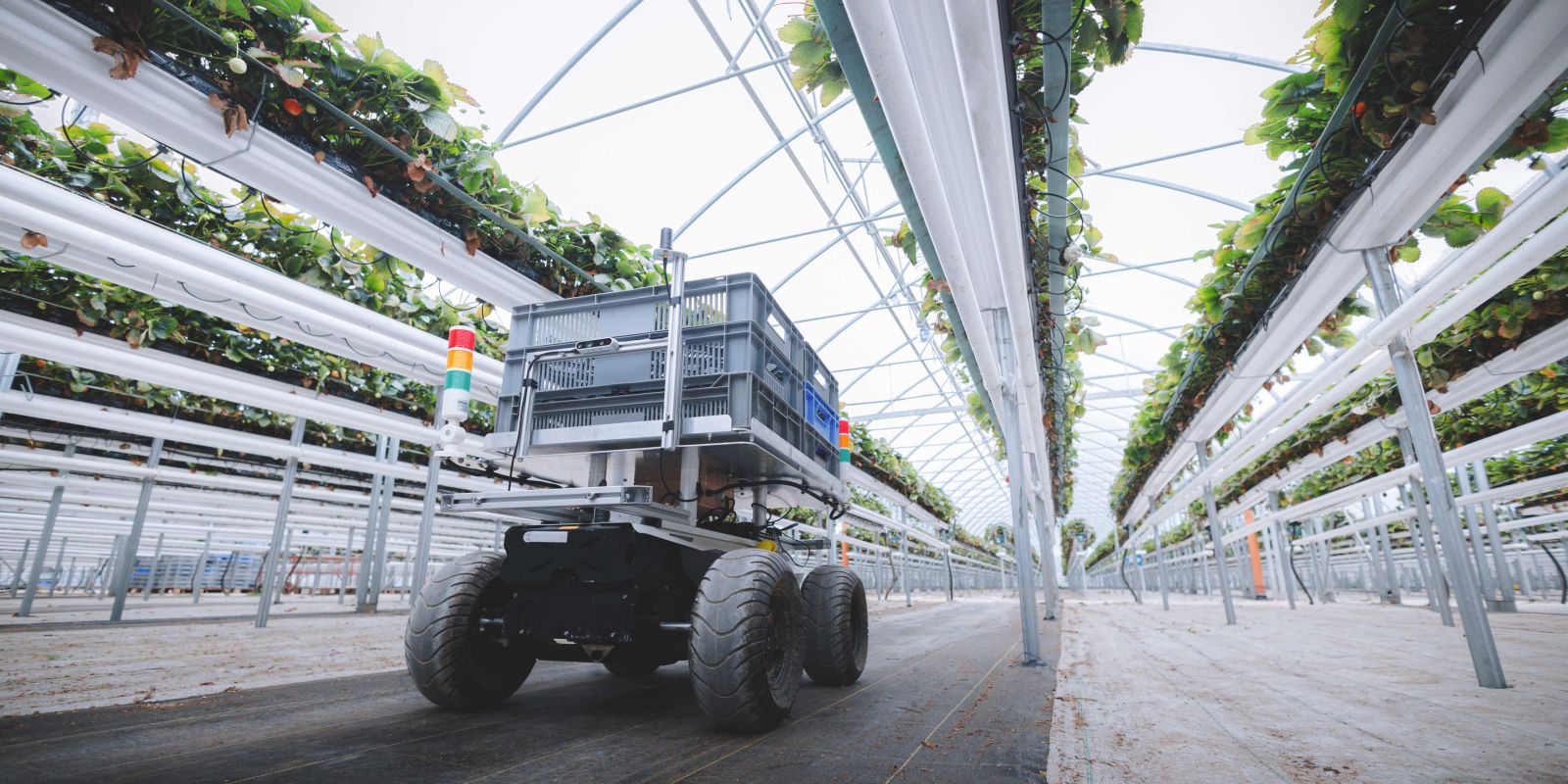
For more than a decade, Professor Marc Hanheide has led research into autonomous systems through the Lincoln Centre for Autonomous Systems (L-CAS), focusing on a deceptively simple question:
How do robots navigate safely and reliably outside the laboratory?
Professor of Intelligent Robotics at the University of Lincoln and CTO of University spin-out JABAS.AI, Marc highlighted that the team’s focus is on creating systems that can operate reliably in complex, real-world environments.
The challenge is particularly significant in agriculture, where robots must operate across vast, ever-changing environments. Farms differ from site to site, weather conditions constantly change, and technologies such as GPS can become unreliable in locations such as polytunnels, vineyards or areas with poor signal coverage.
“We’re laser-focused on robot navigation,” Marc said. “We want to help growers, technology developers and manufacturers deploy robots at scale without everyone having to reinvent the wheel.”
Marc highlighted the scale of the challenge by pointing to the UK’s strawberry industry.
“There are around 40,000 kilometres of tabletop strawberry growing systems in the UK,” he said. “That’s roughly the circumference of the Earth. You simply can’t manually teach a robot every route it needs to follow.”
Instead, JABAS.AI can use satellite imagery to rapidly generate operational maps, helping robotic systems scale far more efficiently across different sites.
These same challenges exist in many other sectors.
"Whenever you use the phrase 'navigation in GPS-denied environments', people become interested," Marc explained. "There are shared technical challenges between agriculture and defence, particularly around reliable navigation, autonomy and operating in environments where satellite signals may be unavailable or unreliable."
At JABAS.AI, a University of Lincoln spin-out launched in 2026, the focus is on providing exactly those capabilities. The company has developed autonomy software that enables robots to move reliably through agricultural environments while reducing dependence on satellite navigation.
The technology can be integrated into a wide range of robotic platforms, from crop-monitoring systems to autonomous harvesting and logistics vehicles, providing what Marc describes as the missing piece that many agricultural robotics companies need to scale.
As the UK seeks to strengthen both food security and national resilience, increasing attention is being paid to technologies that can serve multiple sectors. Known as ‘dual-use innovation’, these technologies are developed for one application but can often deliver benefits across others, including agriculture, logistics, infrastructure and defence. While dual-use technologies are often discussed in relation to defence applications, Marc believes the conversation should also recognise the strategic importance of agriculture itself.
"Defence is about protecting our country, our values and our security," he said. "Food security is a fundamental part of that."
Recent global events have highlighted the fragility of food supply chains, with labour shortages, geopolitical instability and climate pressures creating increasing challenges for food producers. Robotics and automation have the potential to strengthen resilience by supporting productivity, reducing labour pressures and improving efficiency across the food system.
In this context, agricultural innovation is no longer simply about producing more food. It is also about ensuring that food production systems remain robust and adaptable in the face of future disruption.
As automation becomes more widespread, however, resilience must be designed into the technology itself.
JABAS.AI has collaborated with cybersecurity specialists to explore ways of protecting robotic systems from cyber threats, recognising that future automated food production systems must be secure as well as productive.
The journey to commercialisation highlights another important aspect of dual-use innovation - the role of long-term research investment.
The technologies underpinning AI have been developed through more than a decade of research supported by European funding programmes, UK Research and Innovation (UKRI), EPSRC and Innovate UK, alongside collaborations with industry partners across agriculture and logistics.
Repeatedly, the team encountered the same problem. Companies developing innovative agricultural robots were investing significant resources solving navigation challenges independently, despite facing many of the same obstacles.
Rather than creating another robot platform, JABAS.AI was established to provide autonomy as a service - allowing technology developers to focus on their specialist applications while relying on a proven navigation platform.
The company was launched in February 2026 and is already trialling its technology with commercial partners.
Support from Ceres Agri-Tech and the Lincolnshire-Cambridge (LinCam) programmes helped bridge the gap between academic research and commercial deployment, providing not only funding but mentoring, business development support and access to commercial expertise.
For Marc, this combination of research excellence, sector knowledge and commercial support demonstrates how regional innovation ecosystems can help turn world-class research into real-world impact.
The emergence of dual-use technologies also raises important questions for universities and research organisations.
Modern robotics research is highly international, drawing talent and expertise from around the world. This openness has been fundamental to advances in robotics and artificial intelligence, but it can create challenges when technologies have potential defence applications.
Marc believes the solution lies in collaboration and clear recognition of the different environments in which research and deployment take place.
"There are shared opportunities, but there are also different requirements," he said. "Academic research benefits enormously from international collaboration and the open exchange of knowledge."
Rather than viewing agriculture and defence as separate innovation ecosystems, there is increasing recognition that both sectors can benefit from advances in areas such as autonomy, cybersecurity, fleet management and resilient systems.
The technologies emerging from the UK Food Valley ecosystem demonstrate that some of the most important innovations are those that solve fundamental challenges shared across multiple industries.
For Marc Hanheide and JABAS.AI, the goal remains clear.
“We want to be one piece of the puzzle,” he said. “There are many fantastic innovations coming into agriculture. Our role is to help those technologies get out into the field and work reliably at scale.”
In doing so, they are contributing not only to the future of farming, but to a broader conversation about how innovation can strengthen both food security and national resilience.
Marc Hanheide was interviewed by Jess Foster at the UK Food Valley, managed and funded by Lincolnshire County Council.