RETHINKING FENLAND WATER
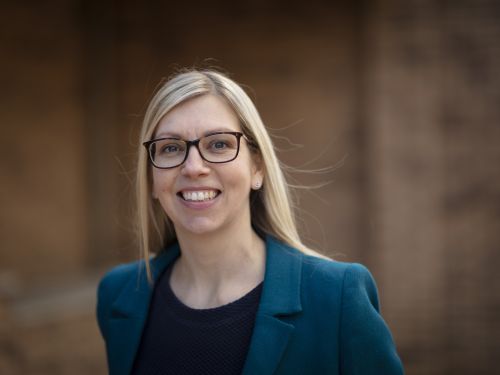
Trina Britton, Managing Director at Thetford Farm Estate, reflects on future-ready water management, extreme weather, and why the Fens need joined up action.
EXCLUSIVE INTERVIEW
The Fens is one of the UK’s most productive agricultural landscapes, but without effective water management, they simply could not exist. Farming in a man‑made basin shaped by centuries of drainage, today’s growers sit at the sharp end of increasingly unpredictable weather patterns, policy constraints and rising costs.
For Trina, the challenge is no longer just about removing water, it is now about learning how to manage it, collectively and intelligently, for the future.
“The biggest concern for us in the Fens isn’t the annual volume of rainfall,” Trina explains. “It’s the amount of water we’re getting in very short periods of time.”
As a low‑lying basin that receives water not only from local rainfall but also from highland carriers draining surrounding counties, Fenland farms are often hit twice during heavy rainfall events.
“When there’s extreme rainfall, we’re watching our drains closely as the water comes down locally. Then, just as that starts to ease, water from elsewhere reaches us through the highland carriers. That’s when the real risk starts.”
This double impact, she says, poses the most serious flooding threat for Fenland agriculture — and it is only becoming more pronounced as weather patterns shift. Historically, the role of Internal Drainage Boards (IDBs) has been clear: remove water efficiently. But Trina believes that approach is now outdated.
“IDBs are legislated to get rid of water. That model no longer works in a world of extreme weather,” she says. “We should be capturing and managing water during high rainfall periods, not just expelling it.”
The Fens, she argues, present a unique opportunity. With extensive infrastructure already in place, there is significant untapped potential to store water temporarily, easing flood risk while creating future irrigation and environmental benefits. One example is rethinking how environmental measures are implemented on farms.
“Why can’t we look at widening ditches and positioning environmental strips alongside them at a lower level?” Trina suggests. “That increases water storage capacity and resilience without flooding productive land.”
However, these changes cannot be delivered by individual farms alone.
“This requires coordination across drainage boards, the Environment Agency, water companies and landowners. Farmers can’t do this in isolation.”
While Trina is encouraged by the willingness of organisations to engage, she feels progress remains slow.
“The same conversations are happening, often with the same people around the table. There’s consensus — but insufficient delivery.”
Drawing on her background in manufacturing and finance, where small margins demanded decisive action, she finds the pacechallenging.
“We know changes are needed. The focus now must be on implementation.”
One of Trina’s more radical proposals is to reconsider how water is valued.
“If water is so critical to future agriculture, why isn’t it treated as a commodity?” she asks.
Currently, water stored outside of clay‑lined reservoirs is generally considered part of the wider watercourse, and therefore under Environment Agency control.
“If farmers are maintaining ditches, creating storage, improving filtration and delivering environmental benefits, why isn’t there recognition or credit for that?”
Assigning value to captured water, she believes, could fundamentally shift behaviour.
“If farmers could generate a return — similar to selling electricity back to the grid — you’d see far more people engaged and investing in solutions.”
In some cases, water storage could even outperform traditional cropping in financial terms, especially on marginal land.
While irrigation often dominates water discussions, Trina stresses that for many arable systems, particularly cereals, it is not the immediate answer.
“For wheat and barley, irrigation isn’t currently viable — the costs just don’t stack up.”
Instead, she believes soil health is the most effective on‑farm intervention available now.
“Improving soil structure and organic matter increases water infiltration and retention. That helps us cope with both drought and heavy rainfall.”
Her own work has involved analysing soil compaction and absorption rates across rotations, but she sees a clear need for better tools.
Looking ahead, Trina believes water management will require new technical skills within farming businesses.
“We need better monitoring, sensors and data analytics to understand what’s happening in the soil across seasons and soil types.”
This kind of intelligence, she argues, will inform smarter decisions on cultivation, rotations and drainage, but only if farmers are supported to adopt and interpret the technology effectively.
Trina is also acutely aware of the financial pressures facing IDBs themselves.
“Rising energy costs have been crippling,” she says. “That affects their cash flow and feeds directly into the rates farmers pay.”
Targeted government support for operational energy costs, she suggests, could help stabilise the system during an already difficult period for agriculture.
Despite the challenges, Trina remains optimistic, provided that water management is approached as a shared responsibility.
“This landscape has always depended on cooperation,” she says. “The future will be no different.”
For the Fens to remain productive, resilient and environmentally valuable, she believes the sector must move decisively from drainage to management and start delivering solutions at the scale the challenge demands.
Trina Britton is MD at Thetford Farm Estates, with responsibility for the overall management of the estate including the arable farm and events. Joining the business in 2016, Trina is an inspirational team leader, with a passion for agronomy, and environmental innovations.
Trina was interviewed by Jess Foster for the UK Food Valley, managed and funded by Lincolnshire County Council.